
The Bruderhof is a Christian communal movement whose members live collectively, share possessions, and organize daily life around religious principles derived from the teachings of Jesus and the traditions of Anabaptist Christianity. Founded in Germany in 1920, the movement emphasizes voluntary poverty, pacifism, communal ownership, and close-knit family life. Bruderhof communities are located in several countries, including the United States, the United Kingdom, Germany, Australia, and Paraguay.
The movement emerged during a period of social instability in post–First World War Europe and developed as an intentional alternative to industrial capitalism and political nationalism. Members live in residential communities where income, housing, and work are collectively organized. Although the Bruderhof has often been compared with groups such as the Amish and Hutterites, it differs in history, governance, and engagement with modern technology.
Over the decades, the Bruderhof has attracted attention from journalists, sociologists, religious scholars, and documentary filmmakers interested in communal living and modern religious movements. Media coverage has frequently focused on how Bruderhof members balance traditional Christian values with participation in contemporary economic and social systems.
Historical Background
Origins in Germany
The Bruderhof movement was founded in 1920 by German theologian and writer Eberhard Arnold and his wife Emmy Arnold in Sannerz, Germany. Arnold had been influenced by the German Youth Movement and by Christian pacifist thought that emerged following the devastation of the First World War. Seeking an alternative to nationalism, militarism, and economic inequality, Arnold established a community centered on shared property and collective religious life.
The name “Bruderhof” translates approximately as “place of brothers.” Early members believed that Christian teachings required believers to hold possessions in common and reject violence. The movement drew inspiration from the Book of Acts in the New Testament, particularly passages describing early Christians sharing material goods collectively.
Influence of Anabaptist Traditions
The Bruderhof was heavily influenced by Anabaptist theology, especially sixteenth-century movements associated with adult baptism, nonviolence, and separation from state power. Members studied the history of groups such as the Hutterites, Mennonites, and Amish. By the 1930s, the Bruderhof had established close ties with Hutterite colonies in North America.
Unlike some traditional Anabaptist groups, however, the Bruderhof emerged within twentieth-century European intellectual culture rather than rural agricultural settlements. The movement attracted teachers, writers, students, and urban professionals interested in communal experiments and Christian socialism.
Conflict With the Nazi Regime
The rise of the Nazi government in Germany created increasing pressure on pacifist religious communities. The Bruderhof opposed compulsory military service and rejected nationalist ideology. These positions brought the movement into conflict with the state.
In 1937, Nazi authorities dissolved the Bruderhof communities in Germany and confiscated property belonging to members. Many Bruderhof families fled the country, first relocating to Liechtenstein and later to England. Continued political pressure and the outbreak of the Second World War forced additional migrations.
Expansion Internationally
During the 1940s and 1950s, Bruderhof communities were established in Paraguay, where religious minorities could practice pacifism without military conscription. Later communities developed in the United States, particularly in New York State and Pennsylvania.
By the late twentieth century, the movement had expanded internationally, operating schools, farms, workshops, publishing initiatives, and manufacturing businesses. Communities were established in Australia and additional European locations. Although membership numbers remain relatively small compared with larger Christian denominations, the Bruderhof developed a visible international presence through publishing, educational outreach, and media engagement.
Religious Beliefs and Philosophy
Community of Goods
One of the central principles of Bruderhof life is the “community of goods,” meaning that property and income are shared collectively rather than owned individually. Members voluntarily surrender personal wealth upon joining the community. Housing, meals, education, healthcare, and employment are organized communally.
This principle is derived from interpretations of the early Christian church described in the New Testament. Bruderhof theology teaches that communal ownership reflects equality among believers and reduces social divisions based on wealth.
Pacifism
The Bruderhof practices Christian nonviolence and rejects participation in warfare. Members historically refused military service and supported conscientious objection. Pacifism remains one of the movement’s defining beliefs and shapes its public statements and educational work.
This commitment aligns the Bruderhof with broader Anabaptist traditions, including Mennonite and Hutterite communities. Scholars of religion have noted that pacifism has historically contributed to both the movement’s identity and its conflicts with governments during wartime periods.
Christian Discipleship
Bruderhof communities emphasize practical Christian discipleship rather than individualistic spirituality. Religious life is integrated into work, education, family life, and governance. Members attend communal worship services, Bible studies, and prayer meetings.
The movement teaches that Christianity should influence all aspects of daily living, including economic organization and interpersonal relationships. Marriage and family life are regarded as central components of communal stability.
Simplicity and Technology
Although the Bruderhof values simplicity, it does not reject modern technology entirely. Communities often use industrial equipment, computers, and internet-based communication for educational and business purposes. However, technology use is generally evaluated according to whether it strengthens or weakens communal relationships.
This distinguishes the Bruderhof from some Amish communities, which maintain stricter limitations on electricity, automobiles, and digital technology.
Daily Life Inside a Bruderhof Community
Shared Property and Finances
Members do not receive personal salaries. Income generated through community businesses is pooled and redistributed according to communal needs. Housing, clothing allowances, meals, childcare, and healthcare are managed collectively.
This economic arrangement reduces distinctions between professional and manual labor roles. Teachers, carpenters, office workers, and administrators are generally supported equally within the community structure.
Housing Arrangements
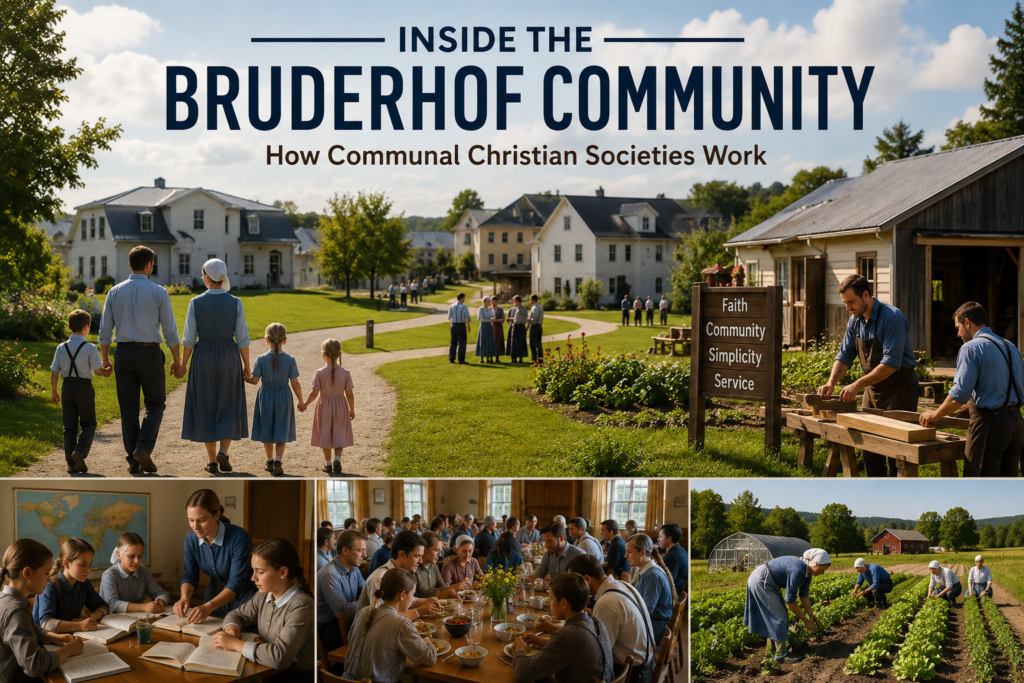
Families usually live in private apartments or homes within larger communal settlements. Although living quarters are separate, communal spaces such as dining halls, workshops, schools, and worship areas form the center of social life.
Communities are often organized to encourage interaction among residents. Shared meals and collective activities play a major role in maintaining social cohesion.
Meals and Community Activities
Most Bruderhof communities eat meals together in common dining areas. Shared meals are considered both practical and symbolic, reinforcing equality and cooperation among members.
Communal activities include worship services, music programs, educational events, and volunteer work. Children often participate in group activities organized around religious education and outdoor recreation.
Education of Children
The Bruderhof operates schools within many of its communities. Education combines standard academic subjects with religious instruction and communal values. Teachers are typically community members, although educational methods vary by location and national regulations.
Children are encouraged to participate in community work and service activities from a young age. At the same time, many Bruderhof students pursue higher education or vocational training outside the community.
Work Responsibilities
Community members are expected to contribute labor according to ability and skill. Work may involve agriculture, manufacturing, teaching, administration, publishing, childcare, or maintenance.
The Bruderhof has developed several businesses that produce furniture, educational materials, toys, and equipment for schools and public institutions. These enterprises provide financial support for community operations.
Worship Practices
Religious services typically include hymn singing, Bible readings, sermons, and communal prayer. Worship practices are relatively simple compared with highly liturgical Christian traditions.
Music plays an important role in Bruderhof religious life. Communities often maintain choirs and musical ensembles that participate in worship and public events.
Economic Organization
Community-Owned Businesses
The Bruderhof finances its operations through collectively owned businesses. One of the movement’s best-known enterprises is Community Playthings, a manufacturer of educational furniture and equipment.
Businesses are intended not only to generate income but also to provide meaningful labor opportunities consistent with community values. Production activities are generally integrated into communal life rather than separated into conventional corporate structures.
Manufacturing and Craftsmanship
Manufacturing has historically been important to Bruderhof communities. Workshops produce furniture, educational materials, textiles, and mechanical products. Many operations emphasize durability, craftsmanship, and practical utility.
Agriculture also remains significant in some communities, though industrial and educational enterprises have become increasingly important economically.

Financial Sustainability
Because members pool resources and consume collectively, the Bruderhof operates differently from market-based households. Financial planning is managed centrally within each community. Expenses such as healthcare, elder care, and education are distributed across the communal economy.
Researchers studying intentional communities have noted that long-term economic sustainability remains one of the major challenges for communal societies. The Bruderhof’s continued existence over several decades has often been cited as evidence of organizational stability.
Governance and Leadership
Decision-Making Structure
The Bruderhof is governed through a combination of communal consultation and appointed leadership. Elders and senior members provide spiritual and administrative direction, while major decisions may involve broader discussion among community members.
Leadership structures differ somewhat between communities, though authority is generally rooted in religious experience and communal trust rather than formal political systems.
Membership Expectations
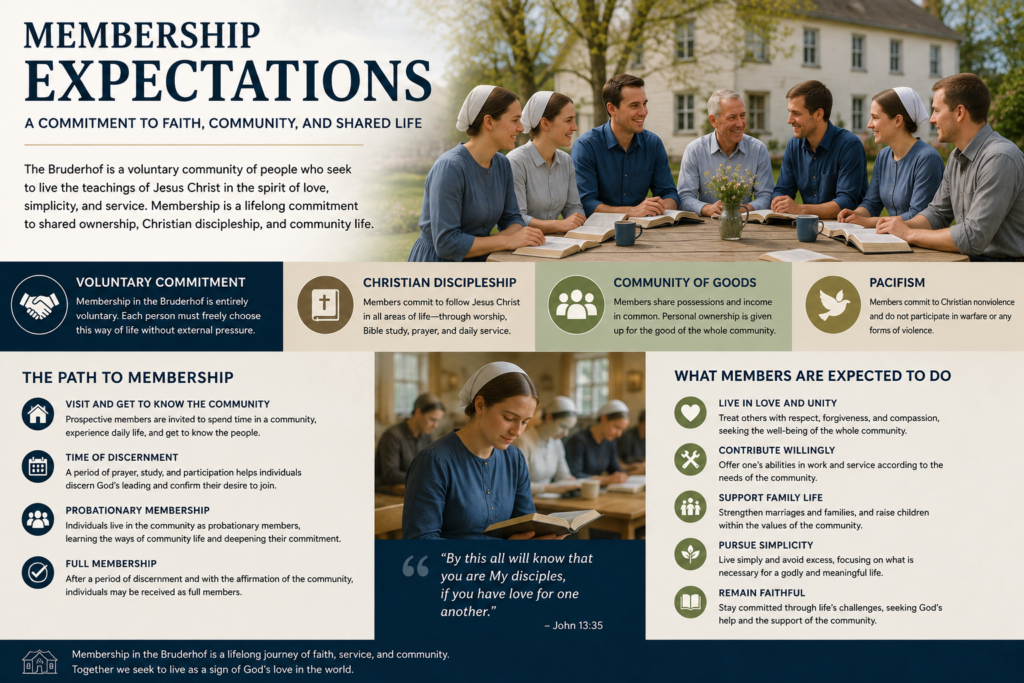
Joining the Bruderhof requires a voluntary commitment to communal ownership, Christian discipleship, and participation in community life. Prospective members often spend extended periods living within communities before formally joining.
Members are expected to contribute labor, participate in worship, and uphold communal values. Individuals may also leave the community voluntarily.
Conflict Resolution
Internal disputes are typically addressed through discussion, mediation, and religious counseling. Communal living can create tensions related to privacy, authority, and personal autonomy, and communities maintain systems intended to preserve unity and cooperation.
Scholars of communal societies have observed that maintaining interpersonal harmony is one of the central organizational challenges in intentional communities.
Relationship With Modern Society
Interaction With Outsiders
Although Bruderhof communities maintain distinctive lifestyles, they are not isolated from wider society. Members operate businesses, interact with government institutions, and participate in public discussions about religion, education, and social ethics.
The movement has also expanded its online presence through publishing, podcasts, and public lectures.
Media Coverage and Public Perception
Journalists and documentary filmmakers have frequently portrayed the Bruderhof as an example of alternative communal living in modern industrial societies. Coverage often focuses on shared property arrangements, pacifism, and family life.
Public perception varies. Some observers describe the communities as stable and cooperative alternatives to consumer culture, while critics have questioned aspects of authority and conformity within communal systems.
Technology and Modern Communication
Unlike groups that restrict modern technology extensively, the Bruderhof selectively uses digital communication and industrial tools. Internet access, publishing platforms, and educational technology are commonly integrated into community operations.
This selective approach reflects an effort to balance communal cohesion with participation in contemporary economic and cultural life.
Comparison With Other Communal Christian Groups
Hutterites
The Bruderhof shares significant theological similarities with Hutterite communities, particularly communal ownership and pacifism. In fact, the two groups maintained formal relationships during parts of the twentieth century.
However, Hutterite colonies are generally more rural and agriculturally focused, while the Bruderhof has developed broader industrial and educational enterprises.
Amish
Both the Amish and the Bruderhof emphasize simplicity, religious commitment, and close community life. However, the Amish typically organize around family farms and maintain stronger restrictions on technology.
The Bruderhof places greater emphasis on collective property ownership and centralized communal organization.
Kibbutzim
Israeli kibbutzim historically practiced communal economics and collective child-rearing, creating structural similarities with Bruderhof communities. However, kibbutzim emerged from secular socialist movements rather than Christian theology.
Many kibbutzim have also moved toward privatization in recent decades, whereas the Bruderhof continues to maintain communal ownership structures.
Intentional Communities
The Bruderhof is often categorized within the broader sociological category of “intentional communities,” which includes ecovillages, communes, and cooperative housing movements.
Compared with secular intentional communities, the Bruderhof maintains a stronger theological foundation and longer institutional continuity.
Criticism and Controversies
The Bruderhof has faced criticism from some former members and observers concerning authority structures, social conformity, and internal discipline. Critics have argued that communal expectations can create pressure to conform socially and religiously.
Some former members have described difficulties associated with leaving the community, particularly when social networks and economic resources are concentrated within communal structures. Journalists and scholars have occasionally examined these issues in discussions of high-commitment religious groups.
At the same time, defenders of the Bruderhof argue that membership is voluntary and that communal systems provide social stability, economic equality, and strong family support networks.
Academic studies of intentional communities generally note that tensions between individual autonomy and collective identity are common across many communal societies, both religious and secular.
Cultural and Media Coverage
The Bruderhof has appeared in documentaries, newspaper features, academic studies, and television programs examining alternative lifestyles and communal societies. British media organizations, including the BBC, have periodically covered Bruderhof communities in relation to religion, education, and communal economics.
Publications such as The New York Times, The Guardian, and religious studies journals have also examined the movement’s history and social structure. Media attention often increases during periods of wider public interest in minimalism, cooperative living, or critiques of consumer culture.
The movement itself has published books, essays, and digital media discussing Christian community life and pacifism.
Conclusion
The Bruderhof represents one of the longest-lasting modern experiments in Christian communal living. Since its founding in Germany in 1920, the movement has combined Anabaptist theology, collective economics, and pacifist beliefs within an organized international network of communities.
Its continued existence reflects both the adaptability and challenges of intentional communal societies in industrialized nations. While supporters view the Bruderhof as an example of cooperative religious life, critics have raised questions concerning authority, conformity, and social boundaries.
The movement remains a subject of interest for historians, sociologists, religious scholars, and journalists examining the relationship between faith, economics, and communal identity in the modern world.
Sources and Further Reading
- Arnold, Eberhard. Why We Live in Community.
- Zablocki, Benjamin. Alienation and Charisma: A Study of Contemporary American Communes.
- Kanter, Rosabeth Moss. Commitment and Community.
- Hostetler, John A. Hutterite Society.
- Encyclopaedia Britannica. “Bruderhof.”
- BBC archives and documentary reporting on communal Christian movements.
- Journal of Amish and Plain Anabaptist Studies.
- The New York Times coverage of intentional communities and communal societies.